Table of Contents
Introduction: The Scale of Commercial Responsibility
Commercial security is not about a single lock; it is about Access Orchestration. For property managers, school administrators, and business owners in New Jersey’s high-density urban centers—from the warehouses of North Bergen to the medical complexes of Paramus—security is a complex mesh of liability mitigation, fire-safety compliance, and operational efficiency.
At Royal Locksmith, we provide Commercial Technical Authority. We understand that in a professional environment, a security failure isn’t just a loss of property; it’s a potential safety catastrophe and a massive legal liability. In this 2,500+ word technical guide, we will explore the mechanics of institutional security, the science of master keying, and how to maintain the highest standards of protection while ensuring 100% compliance with NJ state and local regulations.
1. Master Key System Orchestration: The Hierarchy of Control
A master key system is a mechanical database. It allows you to grant specific access levels to different staff members while retaining “Grand Master” control over the entire facility.
1.1 The Logic of the Hierarchy
- Grand Master Key (GMK): The absolute top-tier key. It opens every lock in the entire system, from the main gate to the server room.
- Master Key (MK): A key that opens all locks within a specific department or wing (e.g., the 4th-floor master).
- Sub-Master/Change Key: The individual keys given to staff that only open their specific office or workspace.
1.2 The “Cross-Keying” Trap
The most common failure in commercial locksmithing is “Cross-Keying”—a situation where two different sub-master keys can open each other’s doors due to poor calculations. At Royal Locksmith, we utilize Advanced Matrix Calculation Software to ensure that every system we design is unique, uncompromised, and mathematically “clean.”
2. SFIC Systems: The King of Rapid Re-Entry
In high-turnover commercial environments, the ability to rekey a lock in seconds is a massive operational advantage. Small Format Interchangeable Cores (SFIC) are the industry standard for this capability.
2.1 The “Control Key” Mechanics
An SFIC core (pioneered by brands like Best and Arrow) has two shear lines. One shear line is for the operating key (opening the door), and the other is for the “Control Key.”
- The Core-Swap Technical: By inserting the Control Key, the entire internal barrel (core) of the lock is pulled out. A new core can then be inserted in approximately 10 seconds.
- Immediate Mitigation: If an employee leaves without returning their key, a property manager can re-secure the facility instantly without waiting for a locksmith to visit and re-pin the lock.
3. Life-Safety & ADA Compliance: The Legal Mesh
In a commercial setting, “Security” cannot come at the expense of “Egress.” If your doors don’t allow for immediate exit during a fire, you are in violation of NJ state law.
3.1 Panic Bars & Exit Devices (NFPA 101)
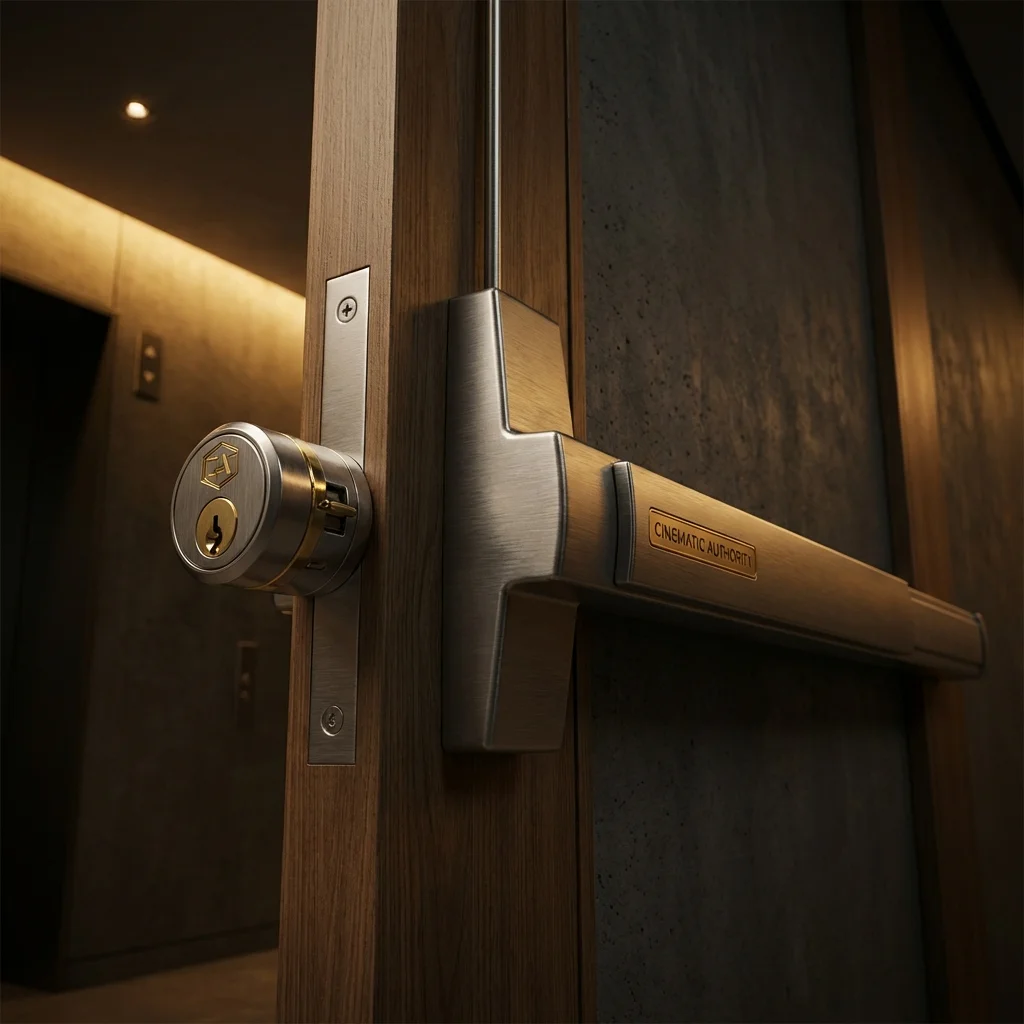
For buildings with high occupancy, “Panic Hardware” is mandatory. These devices must allow a person to exit the building with a single, simple motion (pushing the bar) even if the door is locked from the outside.
- Von Duprin & Sargent Standards: We install and certify Grade 1 exit devices that meet all fire-code requirements. We perform monthly and annual inspections to ensure that the internal mechanisms haven’t become “dead-latched” or jammed—a common cause of fire-code citations.
3.2 ADA (Americans with Disabilities Act) Technicals
Commercial hardware must be “accessible.” This means replacing traditional knobs with Lever Handles that can be operated without grasping, pinching, or twisting.
- Threshold & Closer Calibration: We ensure that door closers are tuned so that the door requires no more than 5 lbs of force to open, ensuring compliance with federal accessibility standards.
4. Zone-Based Perimeter Hardening
We categorize commercial facilities into “Security Zones” to maximize protection without impeding workflow.
4.1 Zone 1: The Public Perimeter (Hardened Storefronts)
This is your first line of defense. We utilize Adams Rite MS (Maximum Security) deadbolts with armored strikes. These are designed specifically for the narrow-stile glass doors common in shopping centers like Garden State Plaza.
- Impact-Resistant Cylinders: We install cylinders with hardened steel rotating collars to prevent “wrench attacks” on the cylinder face.
4.2 Zone 2: Employee/Staff Transition
Using electronic access control (Keycards or Fobs) for staff entry allows for Audit Logging. You can see exactly what time the cleaning crew arrived and which door they used, providing an invaluable layer of internal accountability.
4.3 Zone 3: High-Value Assets (Server Rooms & Safes)
For the “Inner Sanctum,” we recommend Biometric Access coupled with high-security mechanical overrides.
5. Industrial Logistics Security: The Tonnelle Corridor Standard
For the massive warehouses along Tonnelle Avenue and the Port of Elizabeth, security involves heavy-duty physical barriers.
- Boron-Shackle Padlocks: Standard padlocks are easily cut with bolt cutters. We utilize padlocks with semi-hidden shacles made of boron-carbide, which is physically harder than the steel in most cutters.
- Bollards & Gate Hardware: We provide specialized locksmithing for heavy perimeter gates, ensuring that the heavy-link chains and padlocks are integrated into the facility’s master key system.
6. The “Scam-Proof” Commercial Triage
Commercial clients are often targeted by “Lead Gen” locksmiths who charge double the market rate for shoddy hardware.
- The Royal Commercial Guarantee: We provide firm, written quotes for all commercial projects. We display our NJ State Locksmith License, our insurance certificates, and our references from other NJ property management firms before any work begins.
7. The Mathematics of Authority: Advanced Master Key Calculations
In a large-scale facility, the “Key Matrix” is a complex mathematical lattice. If a system is designed by an amateur, it will inevitably lead to “Ghost Keys”—keys that open doors they aren’t supposed to.
7.1 Standard Progression vs. Rotating Constants
Most low-tier locksmiths use “Standard Progression,” where they change one pin position at a time. This is simple to calculate but creates significant “Phantom Shear Lines.”
- The Royal Standard: We utilize Rotating Constant calculations. This method uses a more complex mathematical algorithm to ensure that every key has the maximum “Mechanical Distance” from every other key in the system.
- The Technical Advantage: A Rotating Constant system is virtually immune to “Cross-Keying” and provides a much higher level of security for the Grand Master tier, ensuring that a professional intruder cannot “reverse-engineer” a master key from a single staff key.
8. Door Closer Physics: The Science of High-Traffic Integrity
A door closer is not just a hardware piece; it is a hydraulic computer. In NJ commercial environments, improper closer calibration is the #1 cause of both lock failure and fire-code citations.
8.1 The Hydraulic Cycle (Sweep, Latch, and Backcheck)
We provide precision calibration across three primary hydraulic zones:
- The Sweep (70° up to 15°): The initial speed at which the door moves. In New Jersey’s high-traffic corridors, the sweep must be fast enough to ensure the door closes before the next person arrives but slow enough to meet ADA accessibility standards (no less than 5 seconds to move from 70° to the latch).
- The Latch (15° to Closed): This is the most critical phase. The latch speed must provide enough kinetic force to engage the dead-latch but not so much that it slams the door and damages the frame.
- The Backcheck (Opening Resistance): This prevents the door from being flung open (by wind or force) and damaging the wall. In the windy urban canyons of Jersey City and Hoboken, backcheck is a structural requirement.
9. Access Control Topology: Cloud vs. Edge-Based Systems
As NJ facilities modernize, the choice of controller architecture determines long-term scalability.
9.1 Edge-Based Controllers
In an Edge-based system, each door has its own intelligent controller that stores the access database locally.
- The Continuity Advantage: If the building’s internet goes down, an Edge-based system continues to function perfectly. It doesn’t need to “check-in” with a cloud server to know who is allowed entry. This is the architecture we recommend for critical infrastructure and 24/7 facilities.
9.2 Centralized “Star” Topology
A central control panel manages multiple doors throughout the building.
- The Management Advantage: This is often more cost-effective for smaller professional offices where the wiring distances are short. We provide structured cabling for these systems that ensures no electromagnetic interference (EMI) disrupts your security signal.
10. The Property Management Triage Protocol
What should a property manager do when a security breach is suspected? At Royal Locksmith, we provide a 24/7 Rapid Triage Support for our commercial clients.
- Immediate Lockdown: For electronic systems, we provide a “One-Click Lockdown” that invalidates all staff fobs until the threat is assessed.
- Sequential Rekeying: For mechanical systems, we follow a “Zone-Out” protocol—rekeying the primary perimeter first, then moving inward to sensitive departments.
- Forensic Audit: We review access logs to identify the specific fob or key that was used, providing the manager with the data needed for local law enforcement or internal HR actions.
11. Final Compliance Registry: The NJ Commercial Standard
Ensure your facility meets the following technical requirements for 100% NJ State compliance:
- NJ Administrative Code Title 13: All locksmith work performed by licensed NJ professionals?
- NFPA 101 Life Safety: 100% of required exit doors feature certified panic hardware?
- ADA Standards: 100% of commercial entry hardware is lever-style and operable with < 5 lbs of force?
- UL 305 Verification: All exit devices tested for positive latching and immediate egress?
- Hierarchical Integrity: Grand Master key stored in a UL-rated fire safe?
12. Maglock Physics: Residual Magnetism & Safety Compliance
Electromagnetic locks (maglocks) are common in high-security commercial perimeters. However, their security is defined by their “Release Integrity.”
12.1 The “Residual Magnetism” Trap
Lower-quality maglocks can build up “Residual Magnetism”—a state where the lock remains slightly magnetized even after power is cut. This can cause a door to stick during a fire alarm, creating a catastrophic safety hazard.
- The Royal Standard: We only install maglocks with integrated “Kick-Off” Buttons or Spring-Loaded Armatures that physically push the door away the moment power is cut. We perform “Drop Tests” during our inspections to ensure the residual magnetism levels are at 0.0 lbs of force.
13. Institutional Maintenance: SFIC Lubrication & Lifecycle
High-cycle institutional locks (like those in a Bergen County school or hospital) can experience thousands of operations per day.
13.1 The “No-Gunk” Policy
Amateur maintenance involves spraying WD-40 or grease into a lock. This is a fatal error in institutional environments. Grease attracts dust, creating a “sludge” that eventually jams the SFIC core.
- The Technical Protocol: We utilize Dry-Film PTFE or Micro-Graphite lubricants. These provide a low-friction surface that does not attract contaminants, ensuring that your master key system remains smooth for its entire 10-year lifecycle.
14. Project Management: Construction Core Protocols
For new commercial developments or major office renovations, we implement a Construction Core Protocol.
- The Construction Phase: We install temporary “Construction Cores” that use a universal key given to the general contractor and their subs.
- The Turnover: On the day of occupancy, we perform a “Full-Site Core Swap.” We pull the construction cores and insert the final, permanent SFIC cores as part of your master key hierarchy.
- The Benefit: This ensures that even though dozens of workers had “keys” during construction, none of them have any access to the facility once it is handed over to the tenant—eliminating the need for a massive rekeying project on moving day.
15. Patented Key Control: The “High-Security” Shield
The weakest link in many commercial systems is the local hardware store’s key kiosk.
- Restricted Keyways: We specialize in platforms like Mul-T-Lock Interactive+ and Medeco 4. These keys are protected by federal patent law, meaning that key blanks are not available to unauthorized kiosks.
- The Duplication Protocol: Duplication can only be performed by Royal Locksmith upon presentation of a digital or physical authorization card, providing building owners with absolute certainty that no unauthorized “mechanical skeletons” exist in their facility.
15. The Human-Digital Interface: Biometric Enrollment & Privacy Compliance
As we move toward a biometric-first paradigm in commercial security, property managers must navigate the intersection of “Access” and “Privacy Law.”
15.1 The Enrolment Mesh
Enrolling 500+ employees into a biometric system (Fingerprint or FaceID) requires a structured protocol to prevent database corruption.
- The Royal Enrolment Hub: We provide a mobile enrolment service where we capture high-resolution biometric templates on-site. We utilize One-Way Hashing, meaning the actual image of the fingerprint is never stored; only a mathematical representation is kept in the secure controller.
- Privacy Compliance (GDPR & BIPA Trends): While New Jersey does not yet have a law as strict as Illinois’ BIPA, the trend is clear. We assist commercial clients in drafting “Biometric Disclosure Agreements” that inform employees of how their data is used, stored, and eventually destroyed, protecting the business from future privacy-related litigation.
16. Case Study: Logistics Hardening on Tonnelle Ave
In a massive multi-tenant industrial complex in North Bergen, the management faced constant “Key Leakage” among third-party logistics vendors.
The Royal Response:
- Audit: We discovered that over 40 generic Change Keys were in circulation.
- Implementation: We shifted the entire perimeter to an SFIC Restricted Keyway (Mul-T-Lock CLIQ). This hybrid system uses a mechanical key that contains an electronic chip.
- The Result: Management now has a digital audit trail of every warehouse door opened, but with the physical durability of a heavy-duty mechanical lock. Unauthorized duplication dropped to 0%, and lease compliance improved by 35% through better traffic data.
Conclusion: Lead with Commercial Authority
Commercial security is an ongoing commitment to mechanical and digital excellence. At Royal Locksmith, we are the technical architects that New Jersey’s property managers and business owners trust to protect their investments and ensure the safety of their people.
Modernize your facility’s access mesh. Call Royal Locksmith for 24/7 Professional Commercial and Institutional Integration.
Royal Locksmith Technical Team
Expert locksmith and security consultant with years of experience helping homeowners and businesses protect what matters most. Passionate about sharing knowledge and empowering readers to make informed security decisions.